A Journey into the Tian Shan: Kyrgyzstan 2021
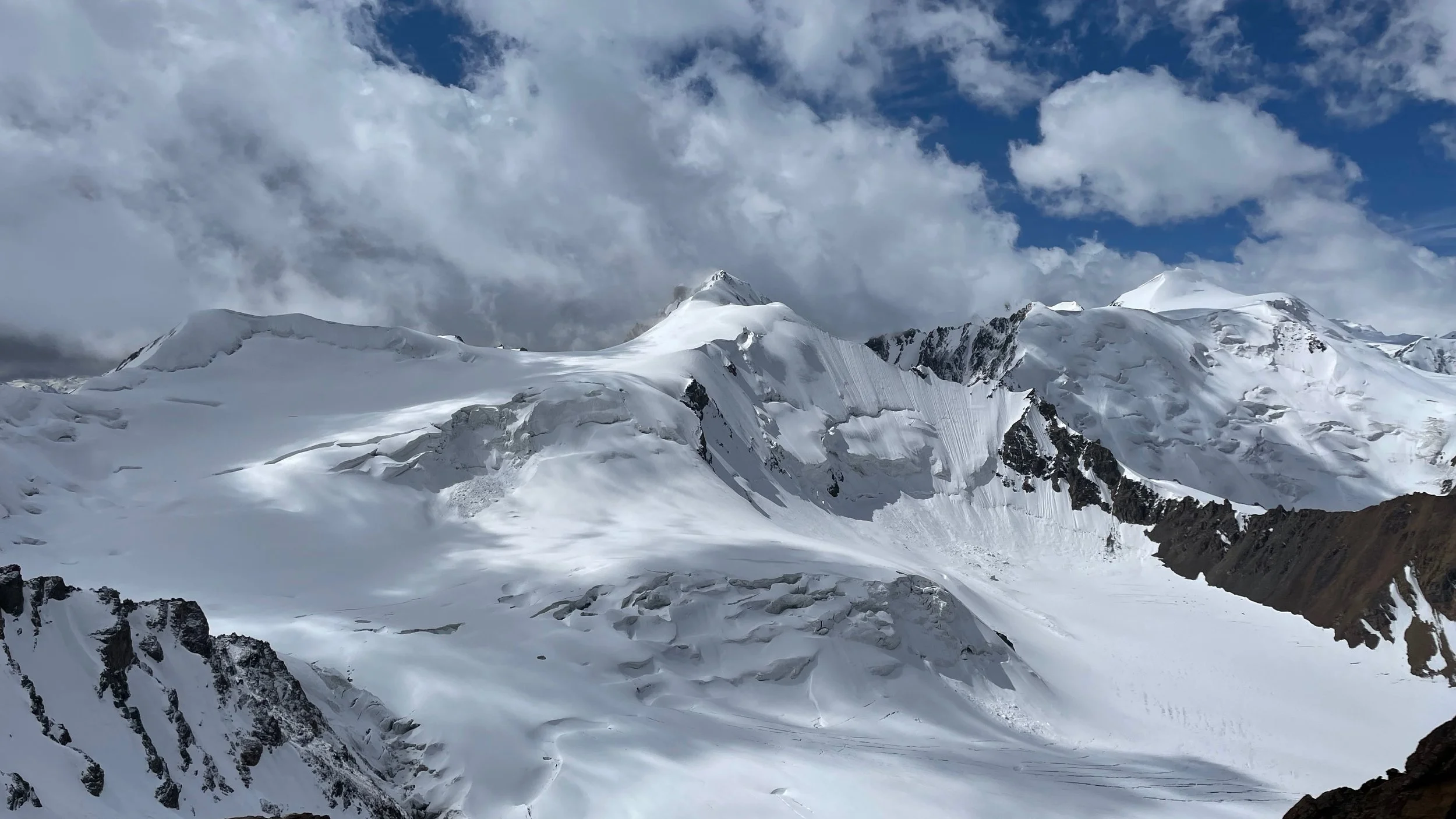
The upper reaches of the East Bordlu Glacier and the northern flanks of Pk 4842, Kuiluu Range, Kyrgyzstan. 14 August 2021.
The smoke from their cheap cigarettes hung suspended in the loft space of the enclosed mess tent. Dense, swirling, suffocating. The soft amber glow of a small kerosene lamp cast deep shadows across the half-dark, the light catching the features of the small cohort of gentlemen now gathered around us. Details were obscured in the haze; colours were muted. A junior officer of the border security forces sat opposite me, his peaked cap resting on the table between us. We discussed football and the weather over steaming mugs of black tea. Laughing at his own jokes and with an air of assumed authority, the young officer helped himself to the tin of biscuits we had offered to our new guests. The muzzle of a battered AK-47, resting across the lap of the sergeant sitting beside me, brushed against my leg. The sergeant dutifully laughed at all the right moments and occasionally reached out across the social chasm between them to relight his officer’s cigarette. We made light conversation as if over dinner.
Half an hour or so passed before a stooped man was brought into the tent. Hatred flashed across Svetlana’s face as the accused was brought forth into the dock. With his hands bound behind his back, the man was forced to kneel in the dirt in the dark corner behind the officer. His ashen face was unreadable; his hunched figure weak and withdrawn. The officer appeared indifferent to his presence, continuing a monologue punctuated only by our measured responses and the sergeant’s cued chuckles.
Save for the gentle roar of a gas stove and the murmur of simmering water as we prepared tea, the tent was otherwise quiet. Thomas sat to the left of the officer, whilst Alex and Sam sat silently towards the end of the table. We were unsure of what to say; our role in this scene was unclear.
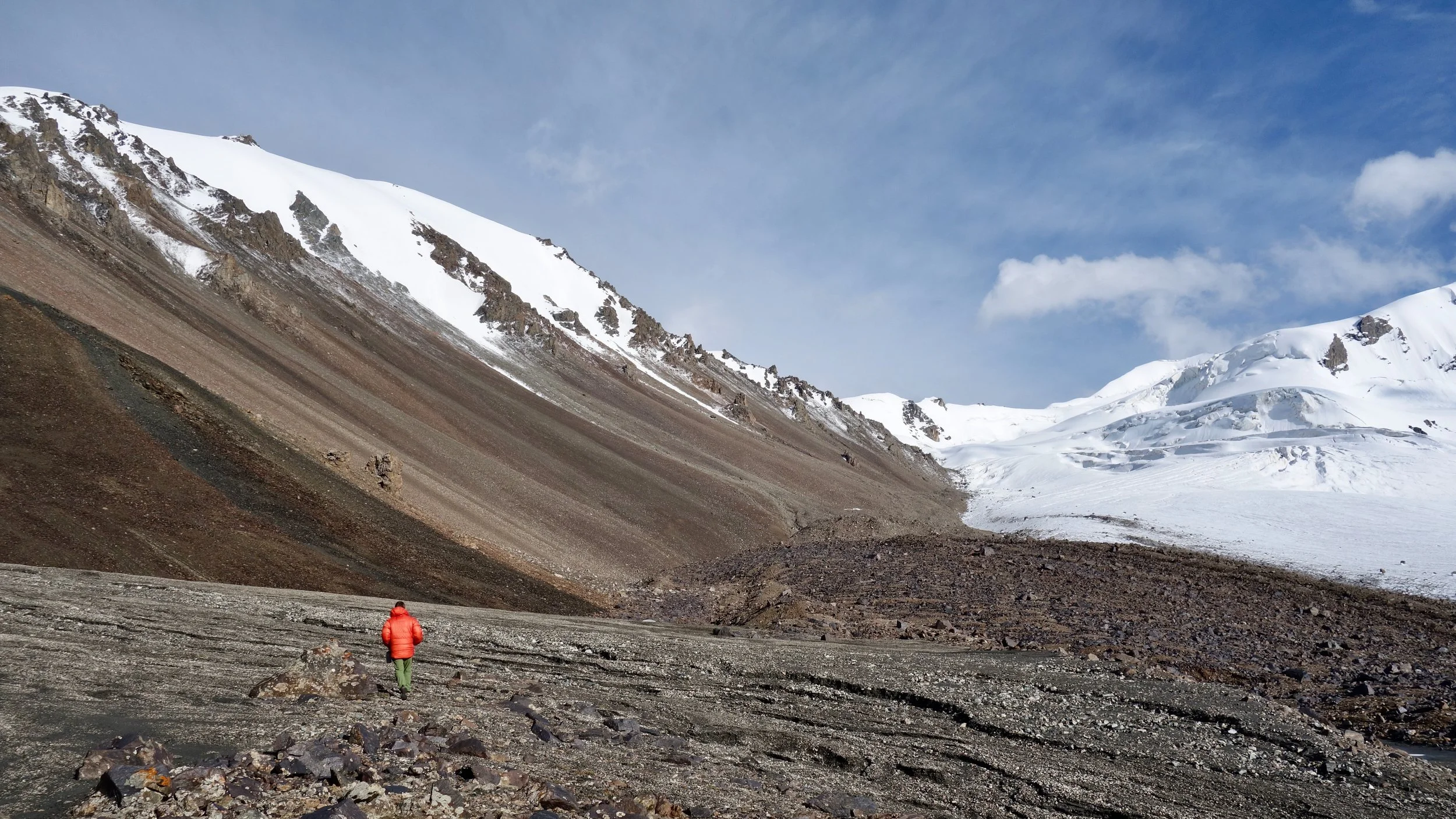
Sam Davies collecting water at advanced base camp on the northeastern flank of the East Bordlu Glacier. 12 August 2021.
Our expedition had started a month earlier, and that we even made it into Kyrgyzstan was quite an accomplishment. COVID had played havoc with our travel plans; our funders were understandably cautious about the latest Foreign Office travel advice, and most of our Montane kit arrived just four days before our planned departure. I can vividly recall several phone calls with Paul Ramsden, who shared our anguish over the damn Amber List. The BMC then gave some rather dubious excuse of a Brexit-related technicality to deny Wayne Auton his climbing insurance, which meant no expedition medic and no altitude drugs, antibiotics, or prescription analgesics. As if this wasn’t enough, Thomas Simpson and I missed our outbound flight after the courier for the express PRC testing company at Heathrow Airport was involved in a motorcycle accident. We hastily rebooked our flights and departed on a new itinerary from Stansted early the following morning.
We touched down in Bishkek in early August. Once a caravan rest stop and now a gateway to the Ala-Archa National Park, the Kyrgyz capital boasts a skyline dominated by the snow-capped peaks of the Kyrgyz Ala-Too Range, which spans some 450 kilometres from the western shores of Issyk-Kul to the city of Taraz in southern Kazakhstan. We strolled down the city’s wide boulevards, lined with rows of trees and flowerbeds, encased by ornate wrought-iron fencing that I imagined was carefully tended by a gardener during Soviet times. Imposing marble-faced public buildings and Soviet-style apartment blocks rose out of the cracked asphalt streets.
Our objective was Pk 4842, the highest of five unclimbed peaks forming a cirque at the head of the East Bordlu Glacier of Kyrgyzstan’s Kuiluu Range. This mass of snow and rock sports a captivating, if unstable, northwest face, forming a formidable barrier to any direct route to the summit. More promisingly, the northeast flank is a series of sweeping snow ramps which might yield access to the final summit ridge. We also had ambitions for the cluster of summits to the east of the glacier, linked together by a series of high-Alpine ridgelines and rocky spurs which sweep down to a sea of ice some 800 metres below. A high camp on the glacier would be our launchpad into this little-visited corner of the great Tian Shan.
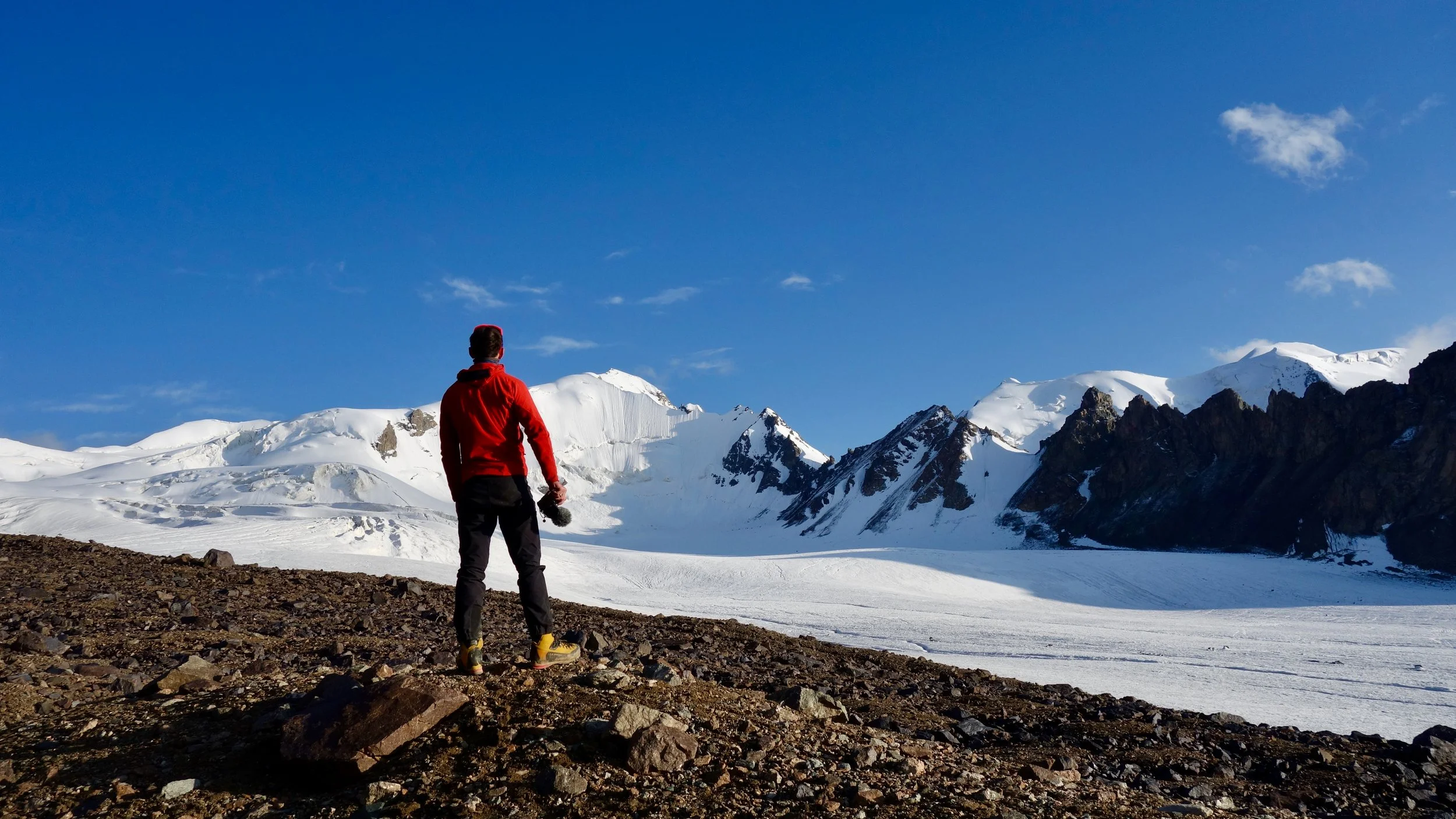
Alex surveying the upper reaches of the glacier and the northern flanks of our primary objective, Pk 4842. 12 August 2021.
Chinese for the ‘Celestial Mountains’, the Tian Shan is a vast system of some dozen or more mountain ranges spanning Central Asia from Uzbekistan to China. Bounded to the north by the Junggar Basin of northwest China, the Great Steppe of southern Kazakhstan, and the Altai Mountains of Mongolia to the north and east, the complex southern frontier is in turn formed by the Pamirs, the Tarim Basin in the southeast, and the Hisor and Alay ranges of Tajikistan to the southwest. The Talas-Fergana Fault, which runs through Uzbekistan, Kyrgyzstan, and Kazakhstan, defines the western boundary. A playground for mountaineers and explorers alike, much of the Tian Shan remains untrodden by human feet.
Alex Metcalfe arrived first in late July and met our expedition cook, Svetlana, before venturing into the backstreet pharmacies to procure the missing drugs. Sam Davies and Sam Mace had also arrived in the capital. I landed in early August with Thomas. Our team, unfortunately, still minus Wayne, was finally in place.
We spent the next day navigating bustling markets to purchase food for the next two weeks, which we packed into blue barrels and old wooden crates under Svetlana’s watchful eye. A visit to ITMC’s offices was like stepping back into the heyday of Kyrgyz mountaineering. Ancient Kamaz trucks and shipping containers filled with Soviet-era climbing handwear filled the storage compound, and decades of expeditions, diligently captured in faded sepia, adorned wood-panelled walls alongside old axes, skis, and steel ice screws. Returning to the hotel that evening, we made our final preparations and got ready to hit the road.
The small white minibus was piled high with bags and boxes. Traybakes and crates of fresh eggs were precariously balanced on stacked duffel bags, which took up every spare seat. We arrived in Karakol on 3 August, stopping to purchase honey from a delightful roadside truck stall. After a night in a small hostel, sorting gear and buying more food, we loaded up the Kamaz and were ready for the adventure ahead.
The six-wheel drive wagon lurched forward as we began the slow grind south. Steppe and plains transformed into sheer walls of loose rock and sweeping valleys, or canyons in the local dialect. Tumbling glacial rivers mirrored rugged mountain ridgelines above. Walls of rock tinted a deep red rose out of verdant foothills. Rivers that are a gentle turquoise at sunrise are a raging silt-laden grey by mid-afternoon, fed by glacial meltwaters descending from sheets of ice baked by a temperate sun.
The Kamaz hauled us deeper into the Tian Shan, passing the occasional checkpoint and waking a dozing, indifferent security guard who, after some rustling through papers, leisurely waved us through. The 6x6 behemoth toiled its way further along the northern bank of the Kuiluu River, weaving between steep canyon walls, charging over small tributary crossings, and powering over a vast expanse of open steppe. We passed small clusters of felt yurts, lone pastoral farmers tending their herds, and the occasional UAZ 452 Bukhanka 4x4 as it slowly burbled along tracks of loose dirt.
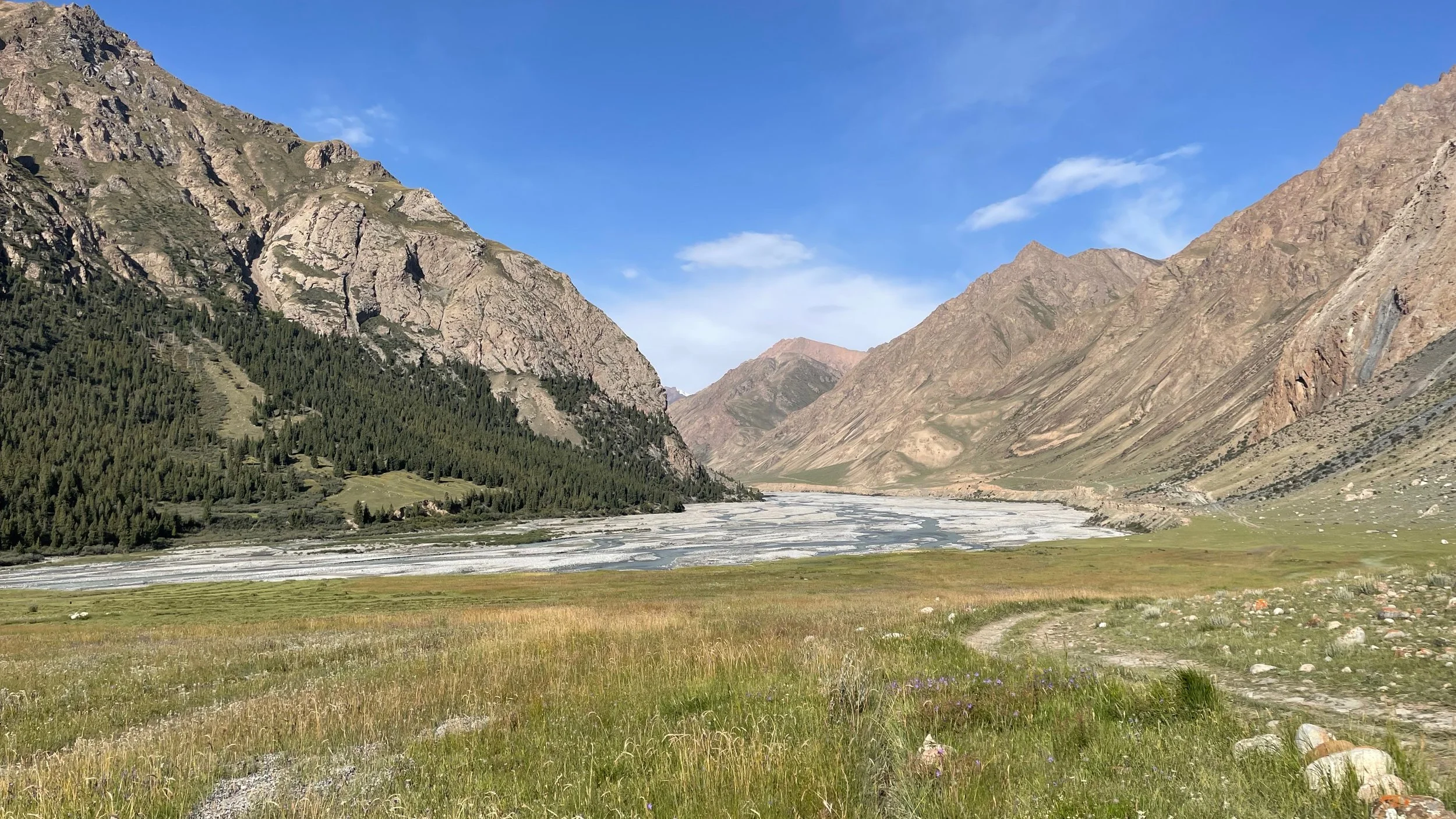
A meandering dirt track weaves between the sheer rock walls, verdant woodland, and complex waterways along the northern bank of the Kuiluu River. 19 August 2021.
By early evening, we reached a point on the northern bank of the Kuiluu River opposite the confluence of the Kuiluu and Bardytor rivers. The latter flows from the Bardytor Glacier deep in the heart of the range and is surrounded by several more unclimbed peaks over 5,000 metres. The Kamaz rumbled down to a crossing point, but we halted for the night on a small islet in the middle of the river; after several attempts to cross, it had become clear there was too much water at this time of day to make it all the way to the other side. Rising early next morning, we packed up camp and completed our crossing before the river swelled again from the glacial meltwaters of the midday sun.
It turned out there was another team in our exact base camp location! They were packing up and using our Kamaz for their return journey to Karakol. How had ITMC neglected to tell us this during the two years of planning for this trip? Fortunately, the team had been climbing in another valley, but had we known this grassy plateau was to be used by another party, we might have reconsidered our plans and perhaps made a last-minute switch to a different area. Anyway, we were here now, so the best option was to stick to our plan to visit the East Bordlu Glacier. We understood the other team might have climbed Pk 4842 from another side, so we decided to focus instead on the other peaks in the cirque, the tallest of which is Pk 4788.
We took several days to establish two gear caches as we slowly acclimatised and explored the Bardytor valley leading to the East Bordlu Glacier. This whole process was made considerably easier by having made the acquaintance of a local herdsman, Argen, who kindly offered us the services of one of his fine horses. The biggest duffel bags were strapped to Argen’s horse, a friendly yet work-hardened animal, much stronger over the river crossings than we were. Once over the rivers, a loose trail over rocky moraine led to Alpine grasslands as we steadily gained altitude.
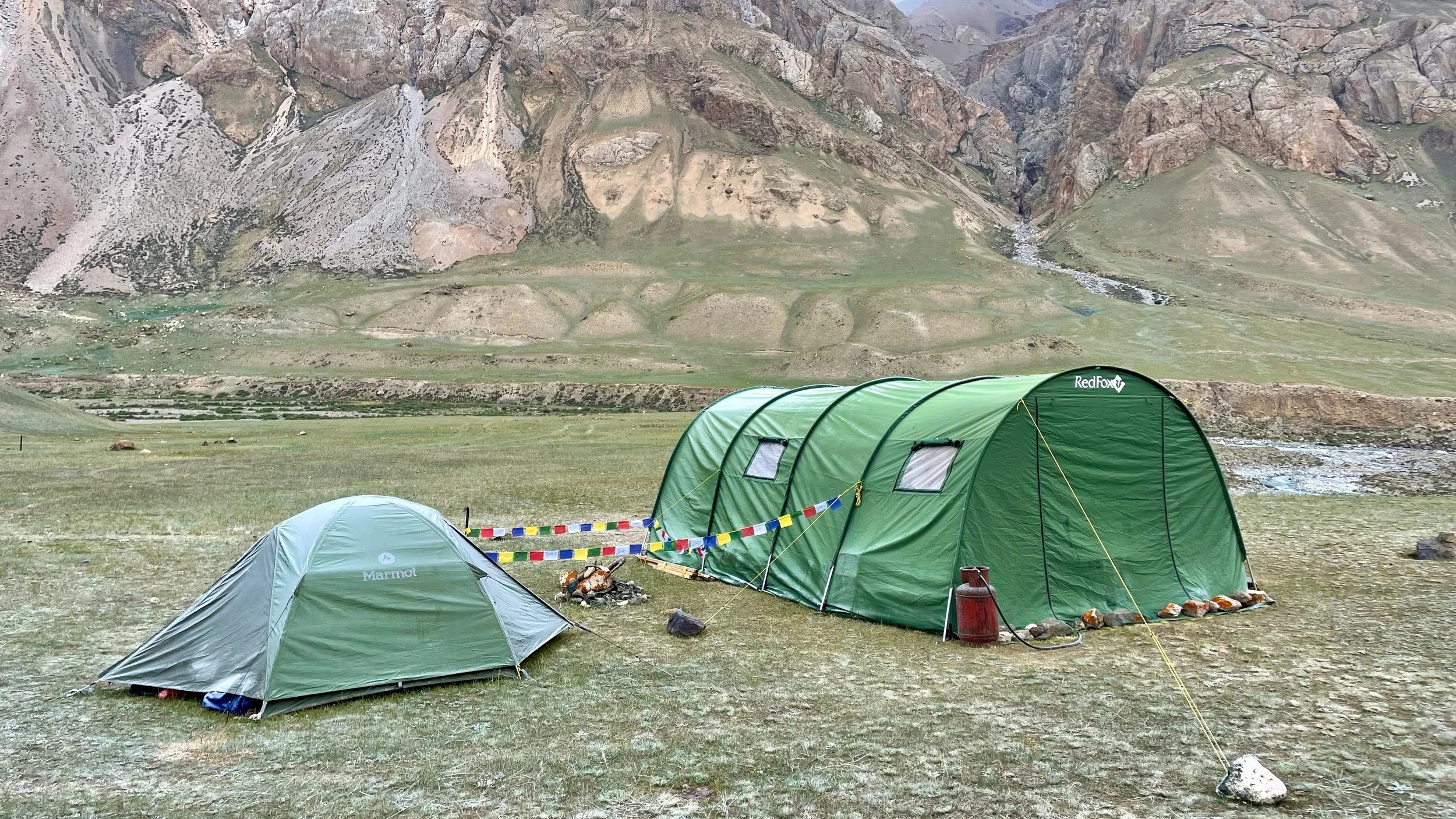
Base camp on a grassy plateau at the confluence of the Kuiluu and Bardytor rivers. 17 August 2021.
By 10 August, we had an advanced base camp established on the moraine on the northeastern flank of the glacier and had returned to base camp for a rest day and to refuel with Svetlana’s excellent cooking. I used the satellite phone to call Wayne, hoping to explore any option that might let him still get out and join us. He was gutted to be stuck in Chamonix, and I felt dejected for him. It was easy to blame the BMC, but in truth, we really had no idea where in the Byzantine world of expedition insurance the problem lay.
Later that evening, I arranged for Sam Mace to be evacuated the following day due to a minor injury. It felt drastic, overkill, and wasteful – a helicopter evacuation for a small cut. But with no antibiotics and another two weeks to go, I was worried about sepsis, and our options felt quite limited.
On 12 August, we made the return journey to our advanced base camp. This moraine encampment was everything I wanted from a first expedition to the Greater Ranges: small, remote, and in a wonderful setting on the flank of a vast expanse of ice and snow. We collected water from a small stream some 50 metres from our tents; it felt wild, isolated, and cold. I felt at home. We packed light Alpine racks, melted snow for tea, and prepared the freeze-dried meals provided by Expedition Foods. As the glacier was swiftly engulfed in darkness, we turned in for the night under a starless sky.
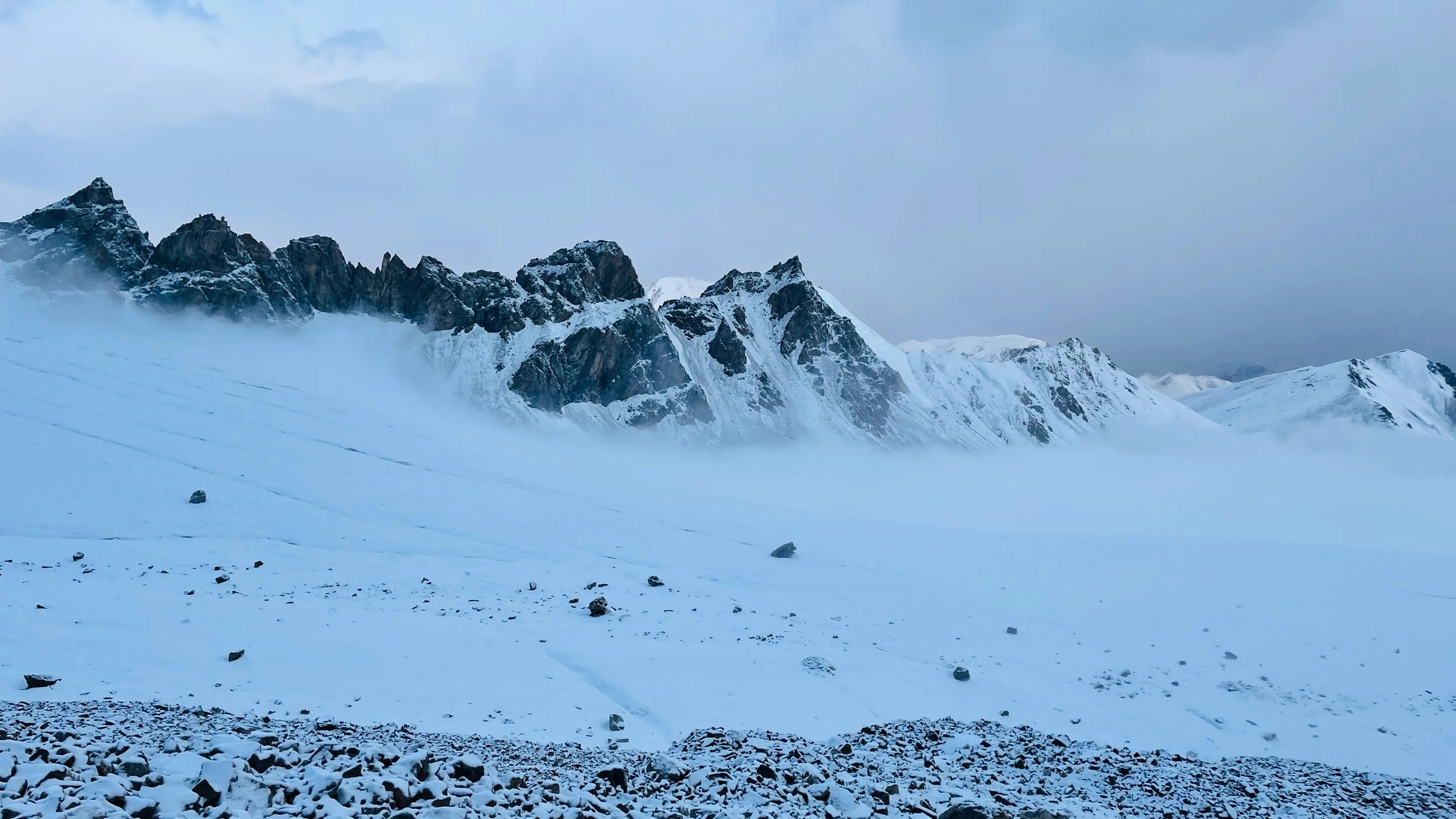
A low mist sits across the East Bordlu Glacier in the cool pre-dawn air. Many, if not all, of these summits remain unclimbed. Most are around 4,000 metres. 14 August 2021.
Despite a night of broken sleep in the small and cramped single-skin tent, I woke an hour before dawn. The air was frigid. After mugs of black tea and a hurried breakfast, we set off up the steep moraine behind camp, and after an hour, we gained the main ridgeline of Pk 4788. I had roped up with Thomas, and Alex had tied in with Sam Davies. Turning southeastwards, we found ourselves on a broad yet spectacular high-Alpine ridgeline. Moving over new terrain, with uncertainty behind every rock, snow, or ice feature, was exhilarating. To the north was Wolf Peak, first climbed by a British team several years earlier and whose expedition report provided valuable insights into the area. After several hours, we found ourselves atop a snowy summit dome around mid-morning. Pausing briefly for high-fives all around and the obligatory summit photographs, we quickly layered up and retraced our steps back down to camp. With a nod to the effort required even to get the expedition off the ground, we named the mountain Perseverance Peak.
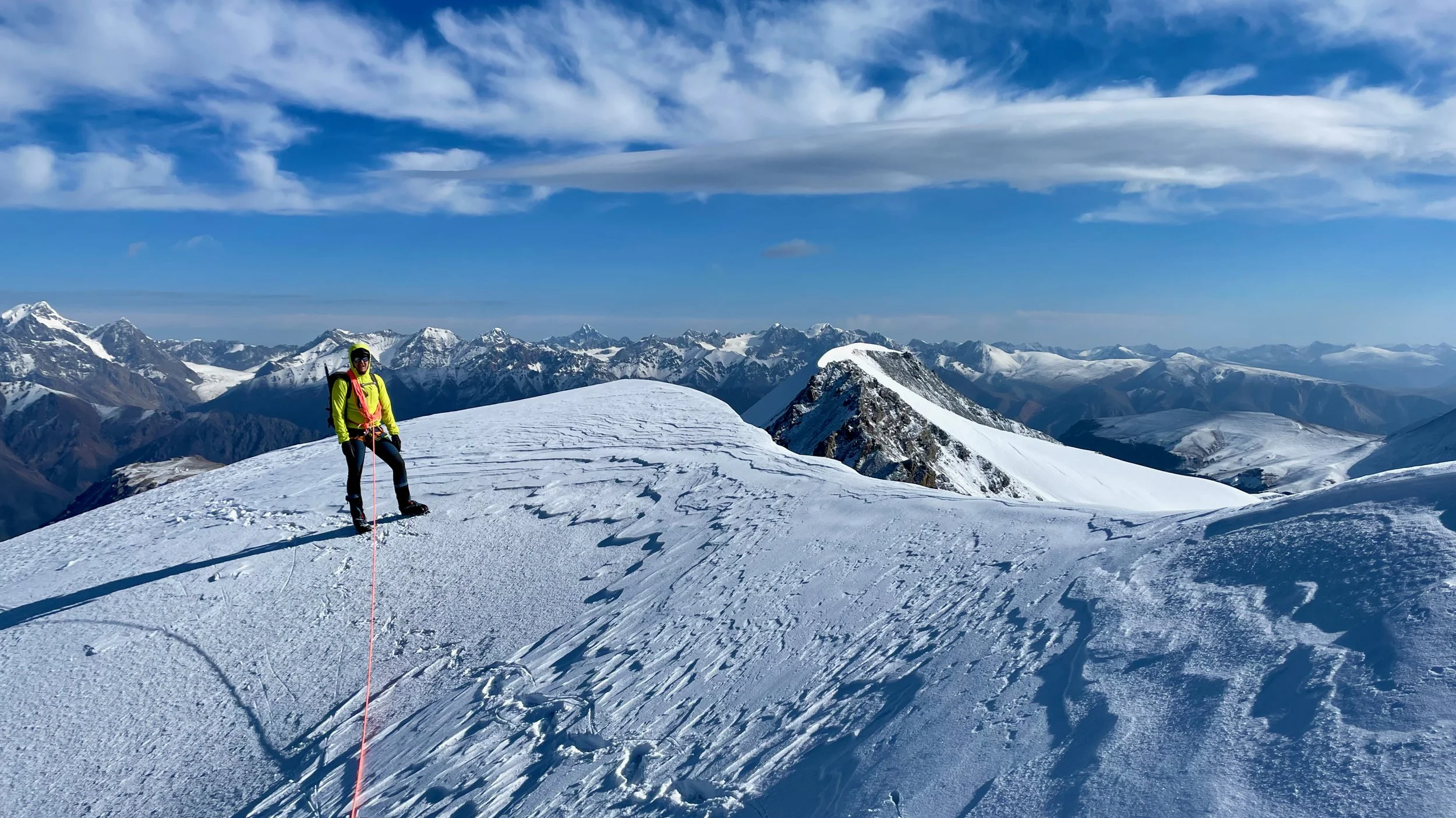
Thomas and I roped together on the high-Alpine ridgeline leading to the small summit dome of Perseverance Peak. From what we can ascertain, many of the distant peaks remain unclimbed. 13 August 2021.
A second route on Pk 4788 hadn’t been a part of the original plan. Still, we had spotted a potentially interesting line that would be a good opportunity to get onto some more technical ground before pushing onto steeper objectives higher up the glacier. Little did we know this would be the expedition’s last day of climbing.
I had a night of mixed sleep; snow had fallen continuously, and we had thought we might be tent-bound for days. It stopped an hour before dawn, as we brewed up in the cold pre-dawn air under a sky of deep Capri blue. By the time we had packed, the snow was falling again. We peered up the glacier, hoping to catch a glimpse of our intended line.
Deciding to go for it but agreeing to turn back if the weather deteriorated any further, we followed the lateral moraine up the eastern flank of the glacier. We gained the west spur of the newly named Perseverance Peak. The spur was formed from a mass of loose rock, which would eventually lead to our first pitch of solid, gently angled ice. Thomas led off first on what we hoped was a steep mixed ridgeline. As it turned out, the rest of the ridge was more broken rock and scree, but at least the snow was firm enough to move with some efficiency. The view over the west spur of Pk 4700 to the south of our position was spectacular. The saw-toothed ridgeline would be a superb objective for an enthusiastic party of mid-grade Alpinists. A potential route following the series of sweeping snow ramps which made up the northeast flank of Pk 4842 was also visible.
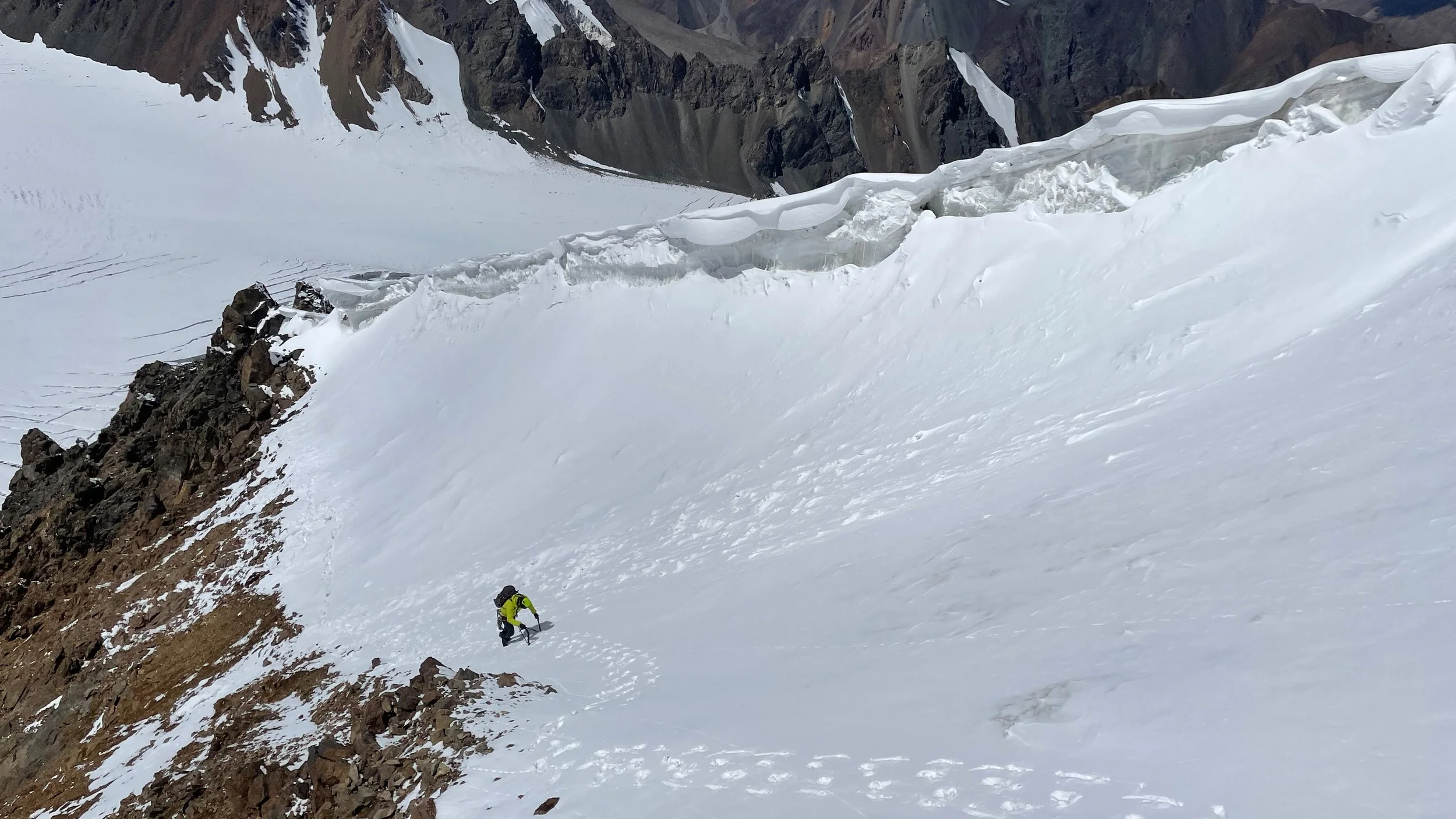
The west spur of Perseverance Peak culminates in a giant snow bowl flanked by wind-scooped cornices and loose rock. We had unroped on the bands of loose rock below. 14 August 2021.
Our spur on Perseverance Peak culminated in a giant snow bowl sweeping upwards towards the main ridgeline. Cornices scooped over the rim, and wind-driven spindrift tumbled into the ether. We cautiously crossed the bowl, wary to avoid the fall line of any cornice debris, and joined the ridge just short of the summit, reuniting with our footsteps from the previous day. The wind had picked up, so we made the call to descend via the normal route. We took a moment to admire the panorama before making our descent back to our tents on the moraine some 600 metres below.
The following day, I returned to base camp with Thomas and Sam, whilst Alex stayed on the glacier for another night to photograph our mystical world at dusk and dawn. Something didn’t feel right as we approached the sweeping plateau I had begun to call home. We found Svetlana and quickly learnt that something was very wrong. We understood there had been an attack at the camp. Svetlana had been assaulted but had fought off the perpetrator. Several of the tents had been slashed, and someone had taken some cash and electronics. But by whom and for what reason? We spent the rest of the morning piecing together what on earth had happened. Kane, a lone horseman and friend or relative of Argen, arrived later that day and returned the stolen items, although we never quite understood how they came into his possession.
In broken English and with some questionable use of a Russian phrase book on our part, we began to understand that the individual responsible for these shocking events went by the name of Azimat, and that during the summer months, he occupied a cluster of dilapidated single-storey stone buildings on the other side of the Bardytor. We had walked past these buildings several times without seeing a single suggestion of life, and were left feeling even more confused. I called ITMC on the satellite phone, and Svetlana and I did our best to convey our situation to our agents in Bishkek.
The following day, around midday, we observed a small 4x4 approaching up the valley and pausing on the far side of the Bardytor. Two men got out and made their way over towards our camp. Argen had arrived by horseback earlier that morning and suggested we prepare to receive our new guests in the mess tent. What happened next was perhaps the most surreal afternoon I have ever experienced.
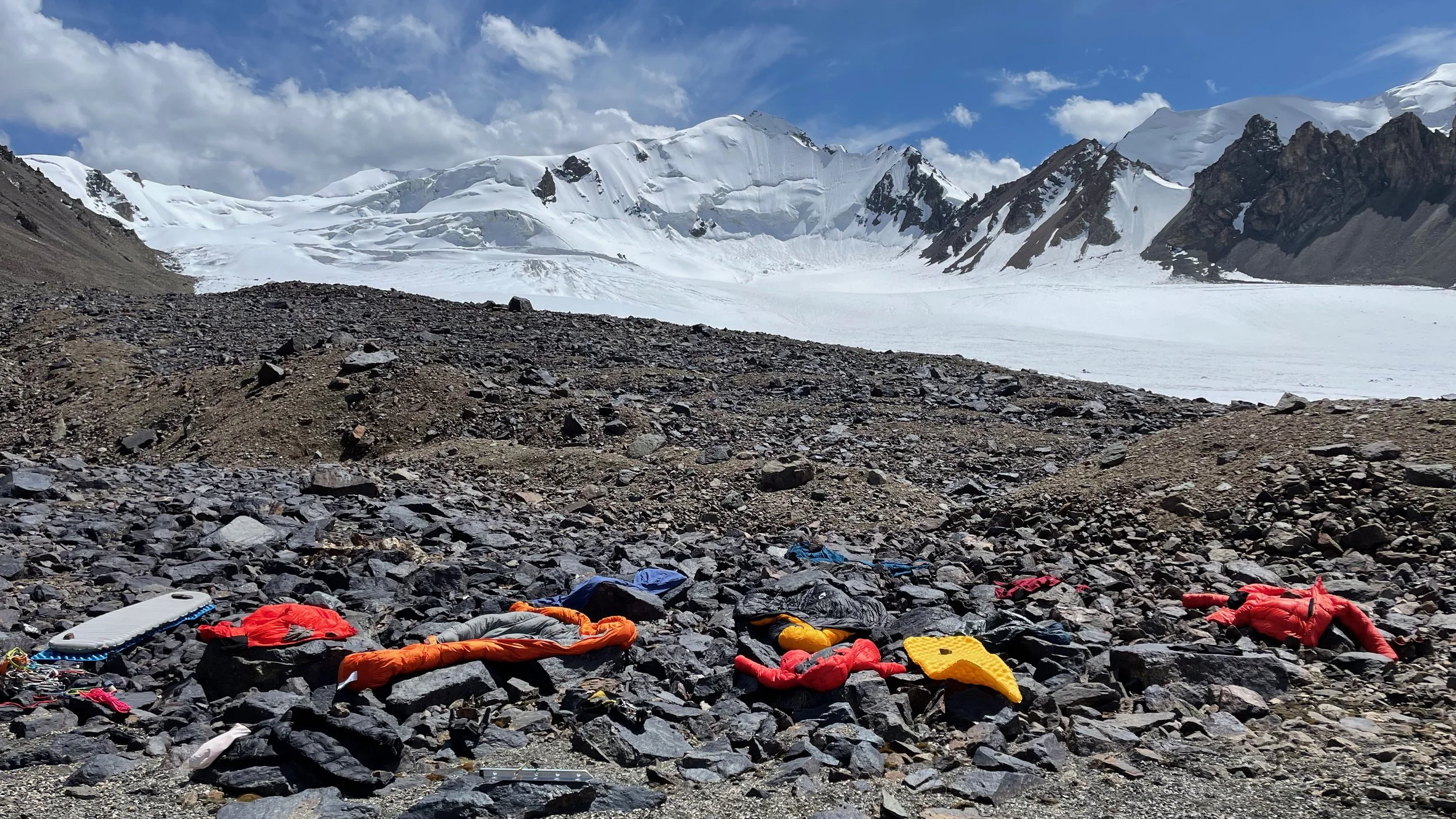
Drying our kit in the afternoon sun after our return from the summit of Perseverance Peak. 14 August 2021.
We later learned that ITMC had notified the police, who in turn had informed the border security forces. Amazingly, they had apprehended Azimat as he attempted to leave the valley by the only road heading back towards Karakol. He was then taken straight to our camp so that Svetlana could confirm his identity. Azimat knelt on the dirt floor, his hands still bound behind his back, as the officer began to question him. This was not a formal interview. No rights were given, and no notes were taken. The officer’s responses were sometimes condemnatory and occasionally mocking. The balance of power was tangible. Svetlana confirmed that this was indeed the man who had assaulted her and slashed our tents. The officer concluded his questioning. He had his confession. The sergeant marched Azimat out of the tent and returned him to the waiting 4x4. We were stunned into silence by the absurdity of the past twenty-four hours. With little else to do, we prepared tea and assisted Svetlana with dinner before retiring, exhausted, for the night.
As if on autopilot, the following days were spent re-establishing communication with ITMC and arranging our extraction from Kuiluu and a return to Bishkek. We had little to do but begin to pack up base camp and reflect on the events that had unfolded. Two years of planning, months of preparation and fundraising, four weeks in Kyrgyzstan, all for two days of climbing. We were all deeply frustrated. Pulling the expedition after just getting started was heartbreaking, but for now our priority was supporting Svetlana and getting ourselves safely back to civilisation. The Kamaz arrived late in the day on 18 August, and we departed for Karakol the next morning.
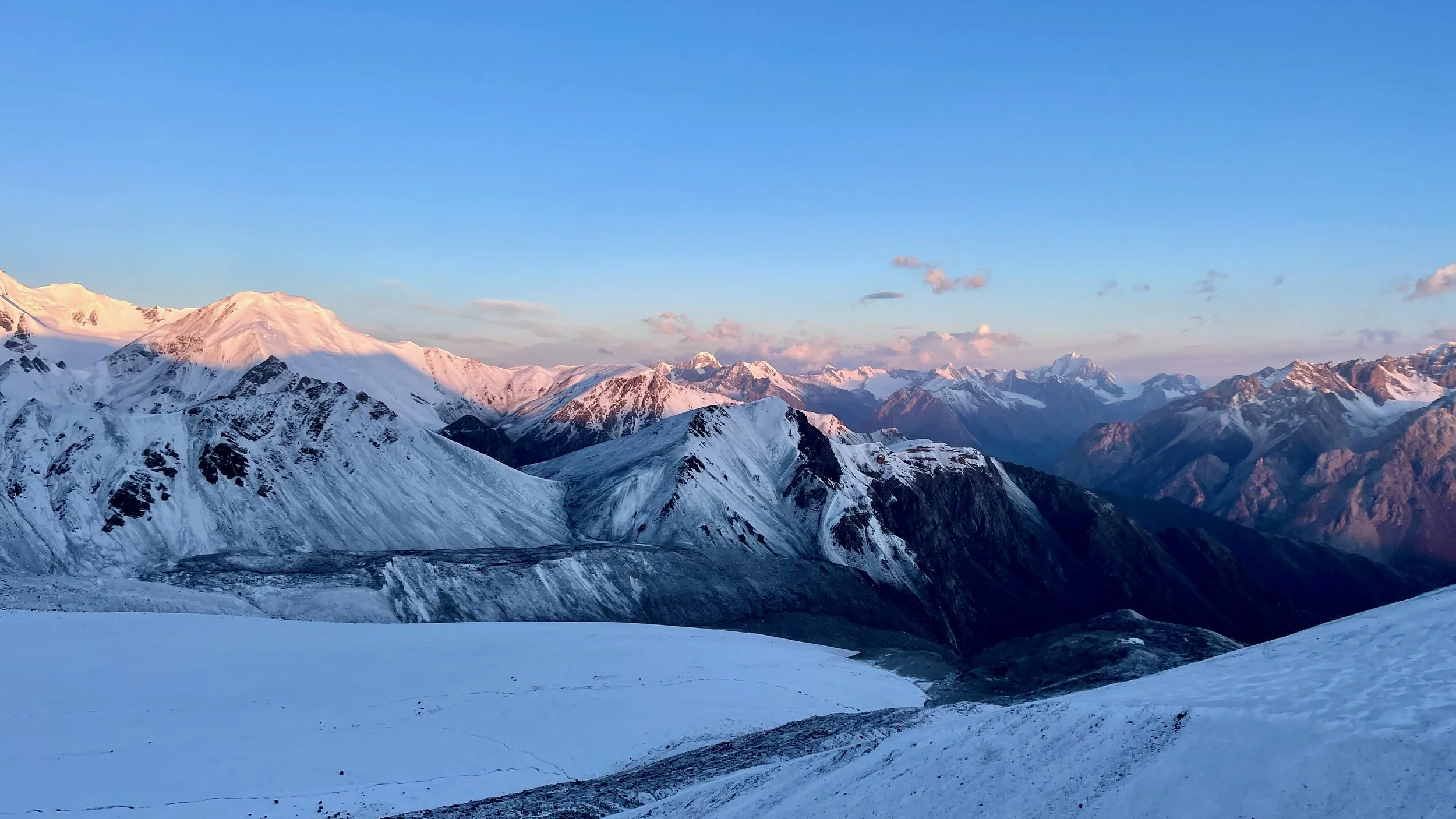
The early-morning alpenglow over the central Tian Shan. 13 August 2021.
In many respects, and despite everything that had happened at base camp, I felt we could call the expedition a success. We had thrown ourselves into the wilds, unsure of what we would find, and had achieved something we could all be proud of. It was a first foray into the world of exploratory mountaineering. A toe dipped in the cold, turbulent, and enthralling glacial meltwaters of Greater Ranges Alpinism.
The Alpine Club Kyrgyzstan Expedition 2021 was endorsed by the Alpine Club and approved by the British Mountaineering Council. Financial support was generously provided by the Mount Everest Foundation and the Alpine Club Climbing Fund. The team is also deeply grateful for the additional support from Montane, Olympus, and Expedition Foods.
Rothera Research Station, Adelaide Island, Antarctic Peninsula, February 2026