Summits & Snowstorms: North Sikkim, India 2023
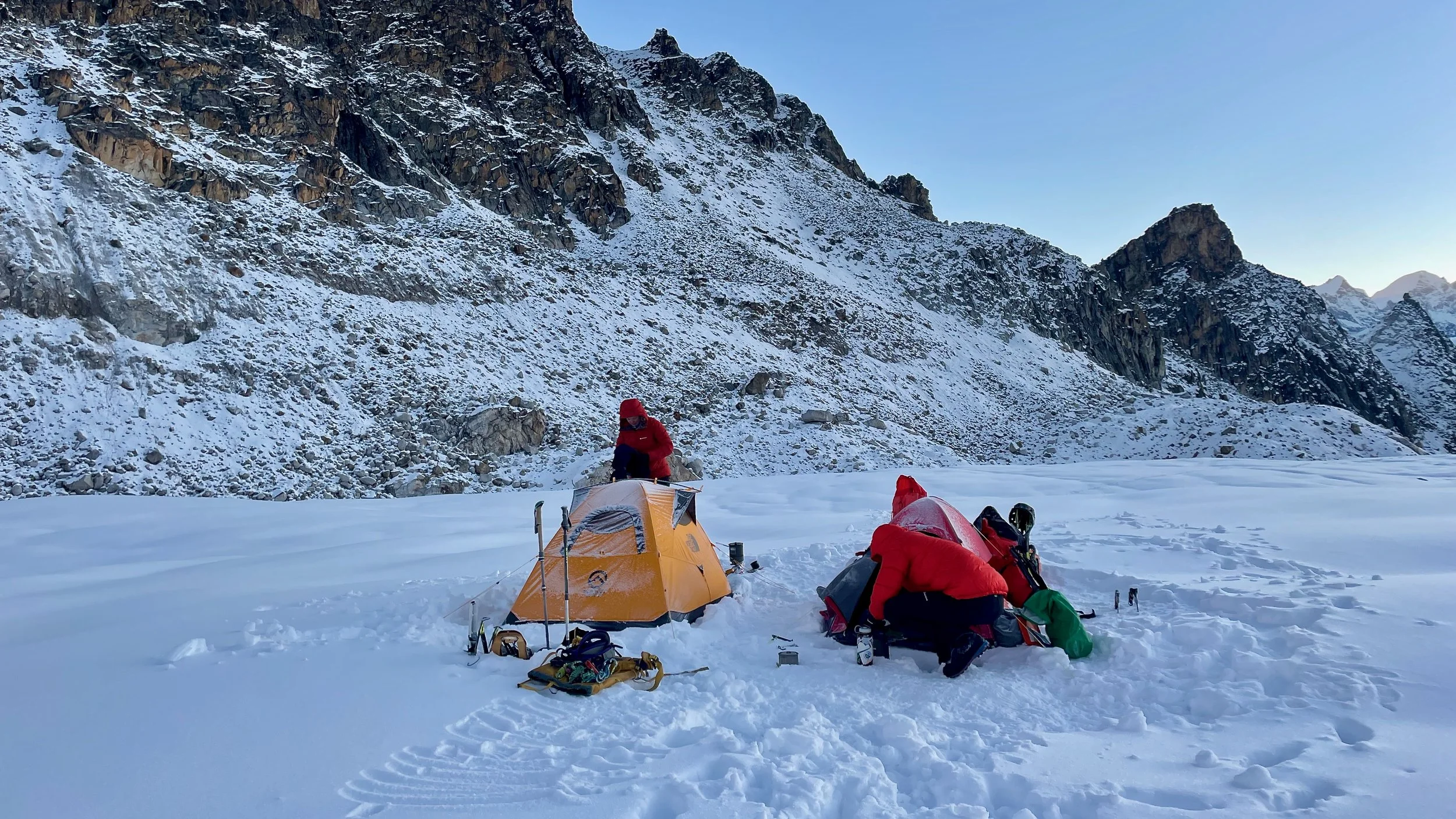
Ula (left) and Thomas (right) going about camp tasks as we make our home on the glacier (5,100m).
The Himalaya. India. These two words are so evocative, so rich in colour and anticipation. I just knew that I had to go. Kyrgyzstan in 2021 had been an adventure and a personal proof of concept; Tajikistan in 2022 had been successful yet heartbreaking. It was time to return to the Greater Ranges, and the Indian Himalaya were calling from somewhere deep within.
We knew Sikkim experienced more precipitation than other mountainous regions of the Eastern Himalaya, but we appeared to have caught the back end of the monsoon season, and the downpours were unrelenting. We spent far longer than planned at base camp, pinned down by skies of dark, thunderous clouds and near-constant clag. Mornings were sometimes drier and gave a brief respite from the soakings, allowing for a flurry of outside activity before we again hunkered down in the mess tent for the remainder of the day.
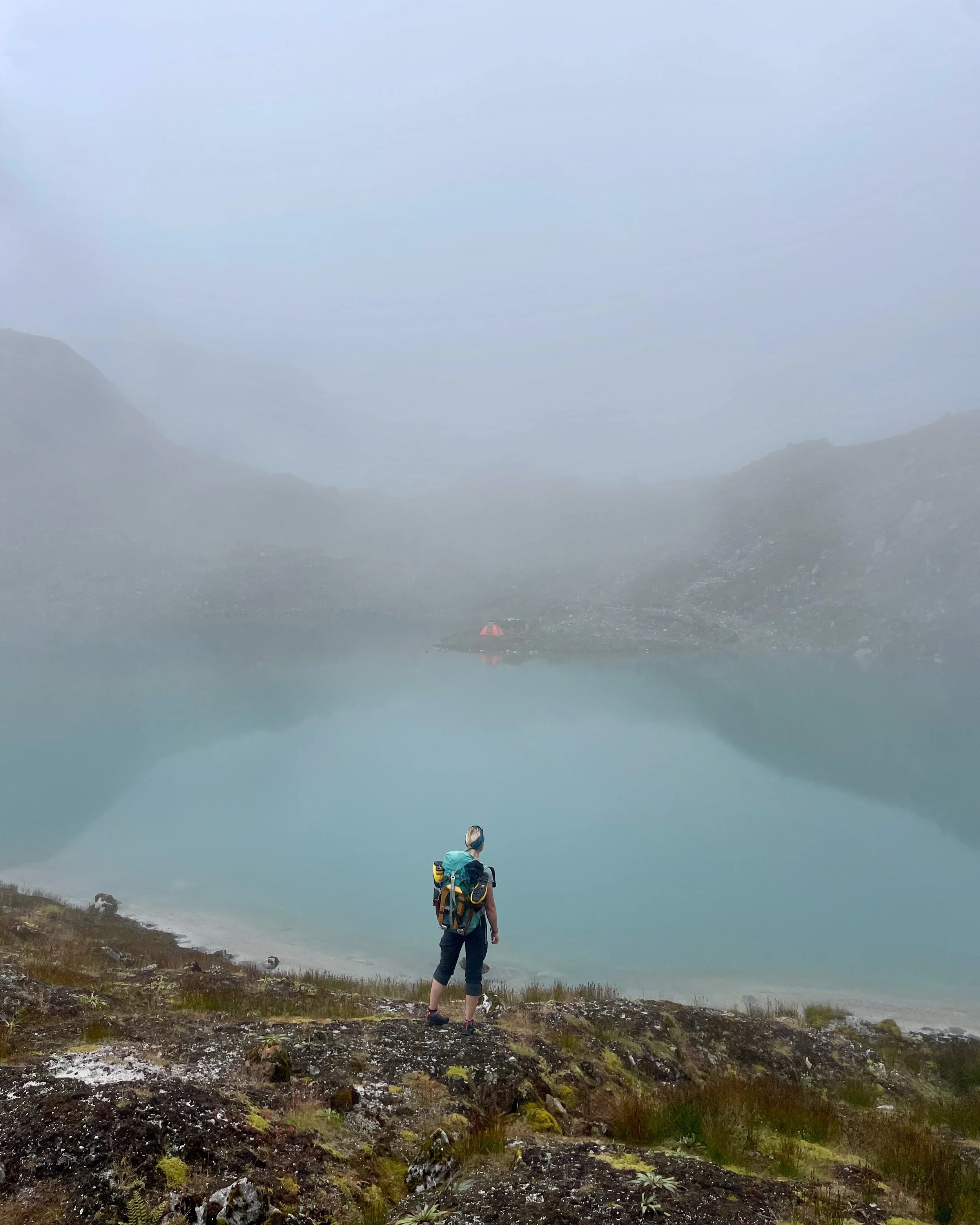
Ula overlooks a small lake, not marked on our maps, where we have established a midway camp and gear cache to better support access to the glacier above.
It is not unusual for heavy afternoon mists to descend on the valley. Swirling veils of snow and rain maintain a state of suspended animation as we wait to be granted access to the higher mountains.
It rained a lot. Base camp became a quagmire as we dug a complex web of drainage channels to prevent the tents from flooding. Drying wet clothing quickly became impossible, and wearing any down garments was out of the question. Higher up, we experienced near-constant snowfall, with collapsed tents needing to be dug out of deep snowdrifts. Most afternoons on the glacier were spent tent-bound.
Despite these challenging living conditions, I don’t believe I have ever laughed so much in a tent. Humour was often our first line of resilience, and team morale was near impenetrable.
On 12 October, after several days of heavy downpours, Thomas Simpson and I return to our tent, established halfway between base camp and the glacier, to find it collapsed under eighteen inches of snowfall. The carbon fibre poles have shattered, tearing large holes in the battered flysheet. We manage to prop it up with two trekking poles to shelter us for the night. At least the clothing and sleeping bags we had left inside are still dry. The following day, we return to the glacier to find the single-skin tents of our advanced base camp buried under a foot of white powder. They are still upright and intact, and the snow is cleared quickly. As the cold begins to settle in around us, we hurry to prepare dinner and tea before nightfall. We go to sleep just after sunset, eager to rest well before an attempt on the nearby unclimbed Pk 5543 the next day.
The snow is deep and simply moving over the glacier is exhausting. With each step, I kick myself a little more for leaving my snowshoes at base camp. A stupid mistake that is costing me energy and my sense of self-worth with every metre we travel. They would have been perfect in these conditions, far more useful on this glacier than crampons alone, and I watch Thomas smugly leading ahead with his snowshoes proudly strapped to his boots. We laugh it off, joking and loudly complaining in equal measure about this damn white powder. It often amuses me how we seek out these snowy lands, drawn to their immense challenge and beauty, yet once immersed, we almost constantly protest about how every aspect of our existence has become more difficult.
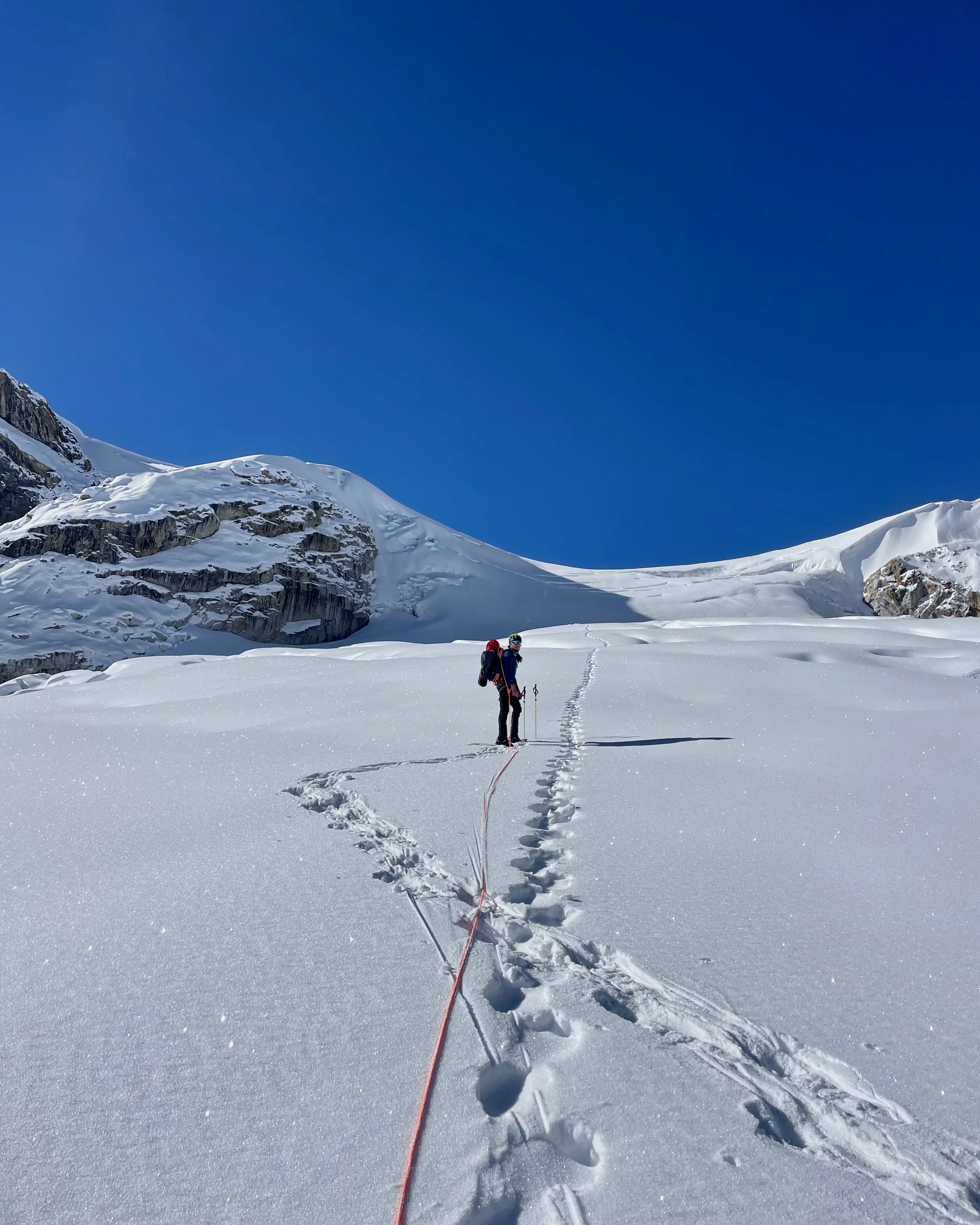
Thomas (in shot) and I make our way to the col at 5,200 metres, which gives access to Dhairya to the left and Thoda to the right. Deep snow saps our energy reserves and slows our progress.
After several hours on the glacier, we reach the col where Pk 5543 rises smoothly to our left. We pause only briefly before continuing to the summit slopes, a small bergschrund posing the only technical difficulty of this otherwise straightforward route. With Ula and Kasia, we enjoy a few minutes on the narrow summit, surveying the sea of spectacular glaciers surrounding our little mountain world. We retrace our steps to advanced base camp; the descent is uncomplicated but soft snow saps energy with every step. By early afternoon the snowfall has resumed, and we have retreated into our tents. Burrowing into our sleeping bags, we are fed and hydrated, and we sleep well. We name the peak Dhairya, meaning patience in Hindi.
On 15 October, we awake in darkness. Crawling from the single-skin coffin we call home on the glacier, we shake off the snow accumulated overnight. Noisily packing our bags and brewing tea, we wake our fellow tent team, Kasia and Ula. Poking their heads into the cold morning air to wave us goodbye, they watch us slowly trudge towards the colossus on the skyline, a single line drawn tight between us. Our objective for today is the 5,604-metre outcrop of snow and rock protruding from the upper glacier and forming a prominent spire amongst the cirque of summits at the head of our glacier.
We start strong, our enthusiasm then waning as we retrace snow-filled steps from the previous day to the col. Swimming uphill through desiccated coconut, we surmount the final snow slope as an assault tent comes into view. We chat with Sam and Elie on the upper glacier; having climbed another new peak the previous day, they are listless and keen to return to the pleasantries of Heera’s cooking. We turn right and gratefully follow their tracks for a time, before branching northwards to tackle our own objective.
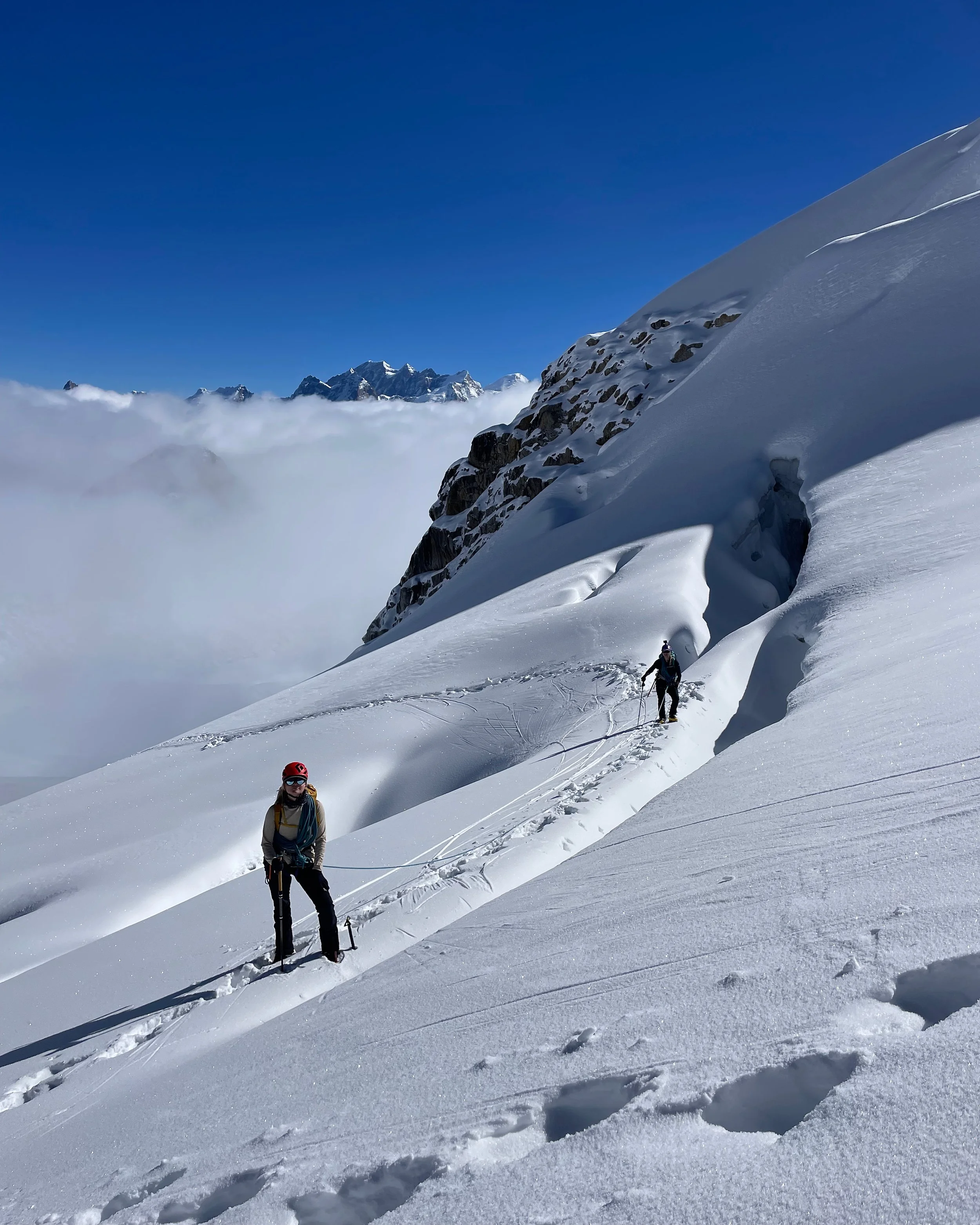
Kasia (front) and Ula adeptly navigate a maze of crevasses as the terrain steepens, approaching the col at 5,200 metres. Clouds hang in the valley below, soon to turn a foreboding shade of gunmetal grey and envelop our little mountain world as the weather deteriorates into the afternoon — a routine phenomenon we are becoming all too familiar with.
On a long snowy finger above, we stop to don our crampons, hydrate, and take in the view. A cloud saunters across the sky, blocking Brumkhangse from view on an otherwise bluebird morning. I take the lead, weaving past a logan stone perfectly balanced atop a column of ice. A short scramble over large blocks and we are on the final snow ramp. Walking with axe in hand, the drop to our left yawns below as we look down upon the cracked and splintering mass of ice that forms our unexplored glacier.
We say very little; the stillness and solitude of a lonely summit are juxtaposed with the trying conditions to get there. A handshake and a photograph cement the memory. A calm, immense beauty surrounds us. Strange moss, a gust of wind, and the tracks of an ibex are the only signs of life on this deserted pinnacle. We name the peak Thoda, meaning a little in Hindi. Our tracks shimmer in the glancing sun on Dhairya beyond, like fresh turns on a ski slope.
The weather turns as we descend. Nearing our camp, we feel very alone. Kasia and Ula have returned to base camp ahead of the predicted cold front. We spend the next 25 hours in our dark cocoon, wishing we were anywhere else.
Simply getting into this tiny single-skin tent is a rather calamitous and highly entertaining affair. The internal space is so small that only one person can make any sort of movement at a time. Thomas often ventures in first. The single front door is opened just enough at its base for the aspiring occupant to dive headfirst into the pile of sleeping bags and warm jackets. I quickly zip the door closed behind him, his boots still comically protruding into the elements, attempting in vain to thwart the flurrying snow which otherwise tends to gravitate towards a small drift forming at the foot of the tent.
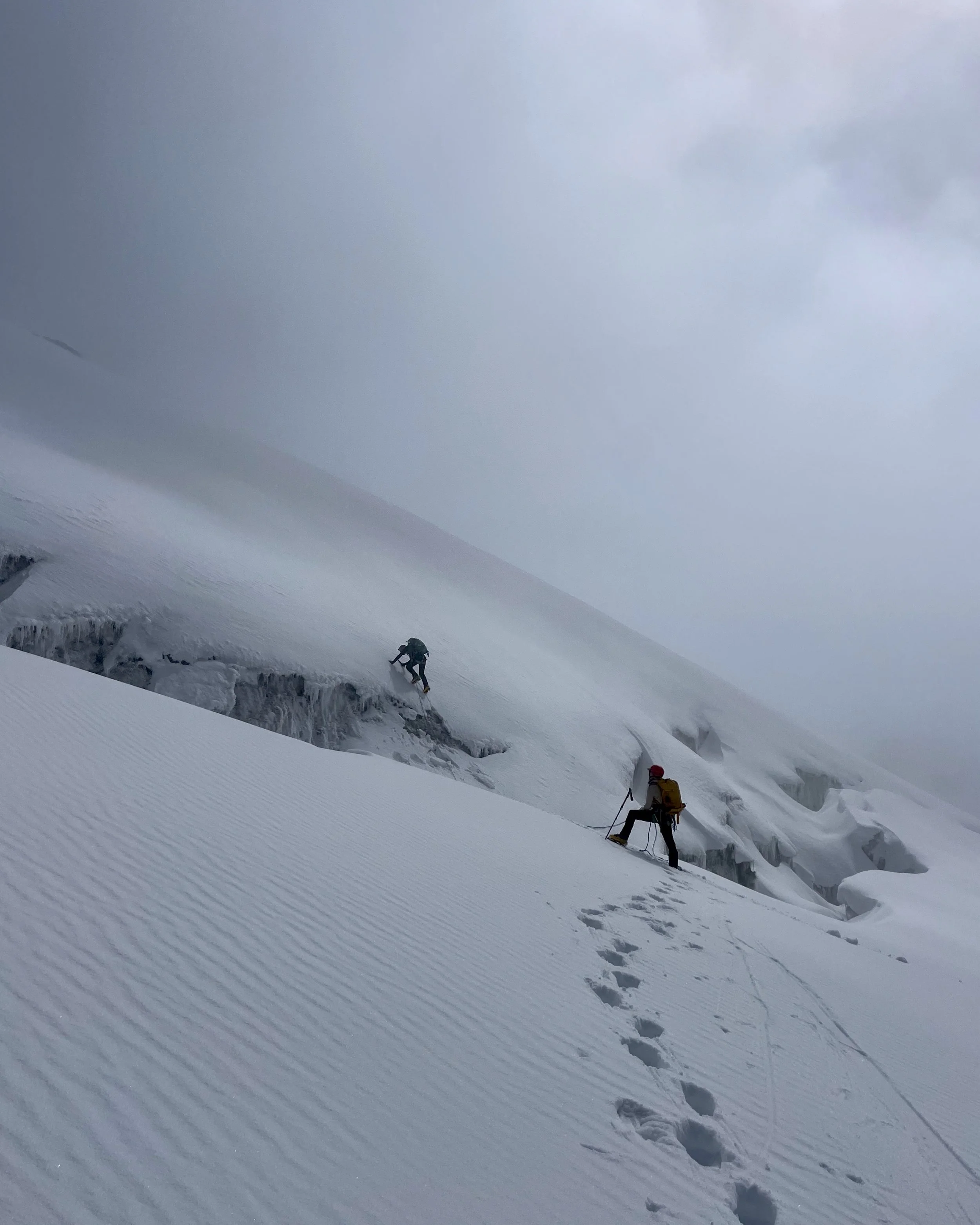
Ula carefully leads our party across the bergschrund and gains the final snow slopes before we make the first ascent of Dhairya at 5,543 metres on 14 October 2023.
The next phase is to remove the double-layer high-altitude mountaineering boots with fingers numbed by the cold, banging off as much rapidly accumulating snow as possible, before swiftly bringing them inside the tent. They get stuffed under the closed-cell foam mats beneath our feet, in an often-futile attempt to prevent our down sleeping bags from getting any damper than they already are.
With one of us successfully sealed inside this small fabric capsule, I turn my attention to the melting of snow and the making of tea, a hot golden nectar that nourishes our dehydrated bodies and our fledgling sanity. The Reactor stove system kindly provided by MSR works a treat and nearly halves the time this task would usually take. With great care, I pass the steaming titanium mug of goodness through a slit in the tent door and into Thomas’s outstretched hands.
Next comes the preparation of freeze-dried meals, a fine art that we have refined over several expeditions and have nearly perfected. Thoroughly shake up the packet, always add a little extra boiling water, stir, stir, stir, re-seal, and leave a minute or two longer than instructed, ideally stuffing into the big internal pocket of a down jacket. Leaving it outside on the snow will cool it down too quickly and prevent optimal rehydration of the contents. I rather enjoy these meals, even looking forward to them, and must thank Expedition Foods for their ongoing support of our antics.
Entering the coffin, as we have affectionately named this small dome of red material, is like stepping into a time machine. With movement so severely limited, one can only shuffle between select positions, none of which are comfortable. We huddle together in search of shared warmth, slowly imprinting our body shapes into the glacial snow beneath us. The tent fabric is just above my nose; hats, jacket hoods, and the baffles of my sleeping bag smother my face, and my breathing is laboured. Perhaps it is the altitude, or perhaps a mild hypoxia as we struggle to keep the vents open, desperately preventing yet more snow from pouring into the tent.
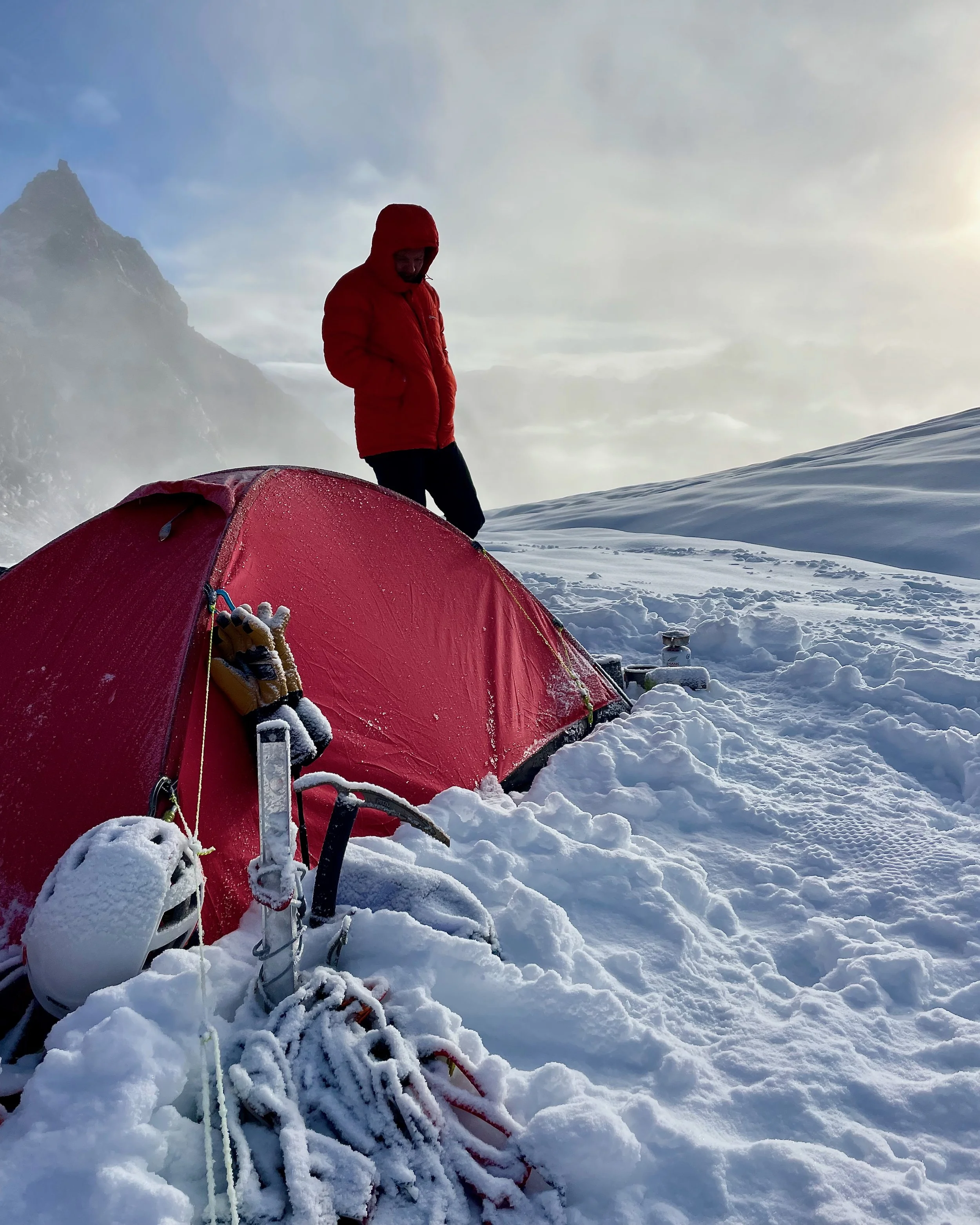
Thomas prepares to melt snow for tea on a frigid morning at our glacial camp. With no room in the tiny single-skin tent for storing gear, we dig a cache at the rear and clip our possessions to the outside of our little red home.
I drift in and out of a sleep-like state; simply resting is the best we can hope for. My perceived reality has become limited to a space just inches in front of me, as if the external world has been closed off. The buffeting wind and snow outside the tent are reduced to a low rumble by the layers of insulation covering my ears. It is as if nothing now exists beyond these four convex walls; I am trapped in this dusky fabric snow cave.
My mind begins to mirror the dark, cold, and suffocating tent. Although I have never suffered from claustrophobia, a strange anxiety and peculiar sense of mild panic begins to settle over me, my thoughts spreading to the darker corners of my psyche. Age-old regrets resurface, and the familiar sense of existential questioning threatens to consume my consciousness. Despite such thoughts, there is no fear in my rational mind; we are safe, well-fed, and hydrated, and the snowstorm will eventually pass.
It is in these moments that I recall the meditative practice of mindfulness; I observe these feelings with detachment, acknowledging their presence, but I do not identify with them. They are my experiences, but I do not let them control or define me. Something that might have once shackled me instead becomes an intellectual curiosity; I simply watch these thoughts form in my mind, observe their presence, and let them calmly drift away. Feeling lighter and oddly content, I soon return to drifting between cold waking and half-sleep, quite bemused by the situation in its entirety. The passage of time has been strangely altered; hours elapse erratically as we wait through the night for daybreak and the hope of clearing skies.
I know I have slipped into a negative mindset, frustrated with the conditions, the short weather windows available for climbing, and the limited options for routes of technical interest and aesthetic quality. This is perhaps the great dichotomy of my experience with expedition mountaineering, for I also feel so privileged to be up here in this awe-inspiring landscape with an incredible team, doing the sport I love.
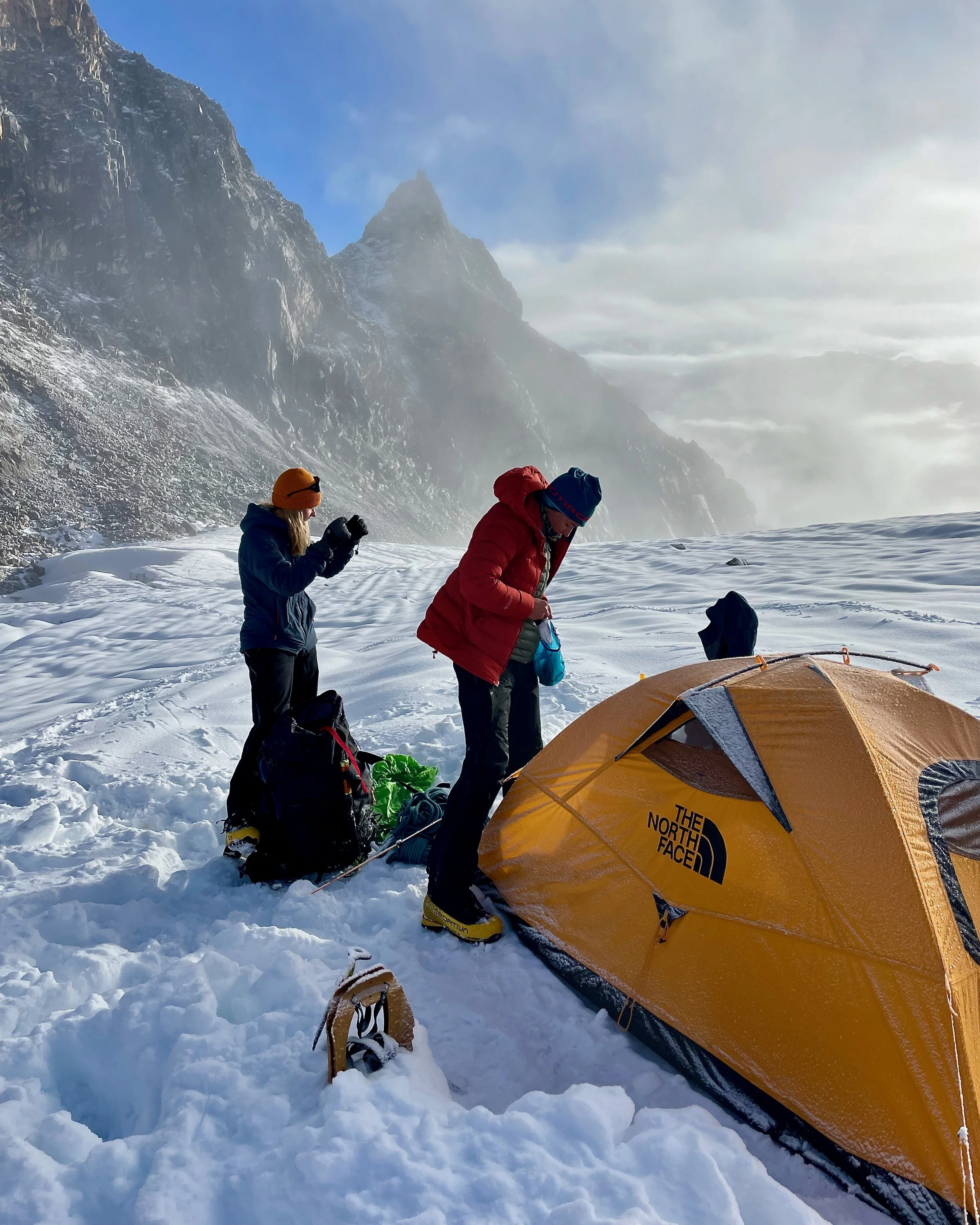
Kasia (left) and Ula organising gear in the deep cold of an early morning as we establish camp on the glacier. Snowshoes and an axe are securely stored, half buried in the snow, and encrusted in a fine layer of frosted ice.
Emerging the next morning, surrounded by fresh powder, we are treated to a beautiful sunrise; the wild landscape is bathed in hues of deep orange and purple. We enjoy breakfast and tea before embarking on the arduous descent to base camp.
Glacial lakes loom through the mist. Thomas slides downhill on his snowshoes, whilst effectively towing me behind, my heavy pack pushing me down with every step. Punching through the crust. Mountain, forest, heathland, and river. Before long, we are back at valley level and collapse into base camp, to enjoy a welcoming cup of sweet masala chai.
I did not fully appreciate how bad the weather in North Sikkim could be, and I did not expect it to be so warm at lower altitudes. We had prepared for snow at base camp, not rain, so our down clothing quickly became useless. Keeping down sleeping bags dry was also a constant challenge. If I were to visit the same region again, I would take more synthetic and less down insulation, refine my layering system, and take a larger single-skin tent for use as an advanced base camp.
I now have a much better appreciation for the diversity of climate and geography across the Indian Himalaya. When selecting new climbing regions to explore, I would gain a better understanding of factors such as average snowfall, temperature, and humidity much earlier in the planning process. Setting a base camp that could be reached by vehicle significantly changed the way I felt about the expedition. I felt as though I could never truly disconnect from the outside world until we established an advanced base camp higher up on the glacier.
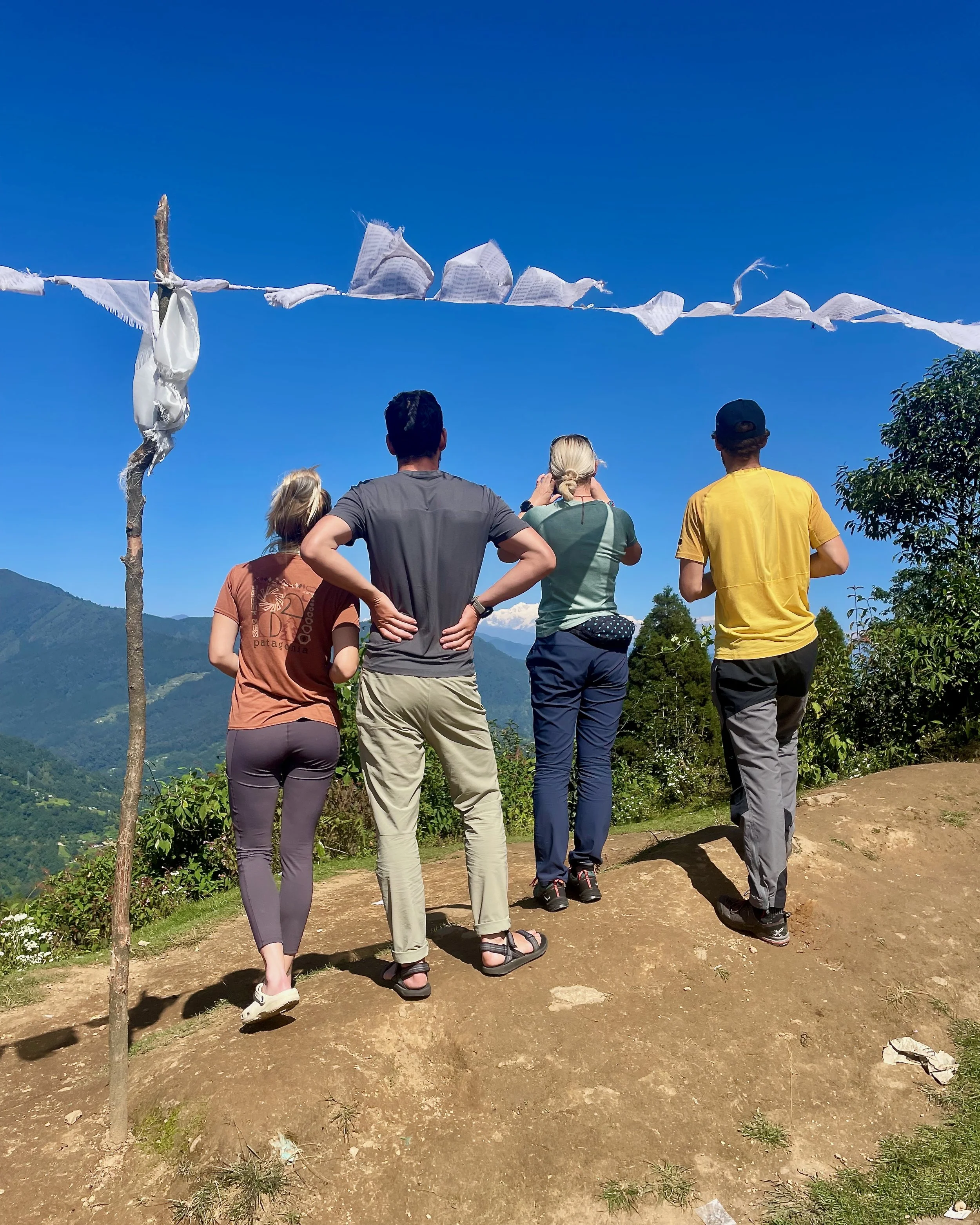
Kasia, Sam, Ula, and Elie take a moment to observe Kangchenjunga in the far distance. Having spent nearly a month in the Eastern Himalaya, we are nearing the end of our time on the Indian subcontinent. We pause to reflect on everything we have achieved.
I also have much refinement and development to do in the Alps. I can be lighter, faster, and more technically proficient, but this takes time and practice. I know I have the potential to climb much harder in the Himalaya, but this is only possible by broadening and deepening my existing foundation in Alpinism.
The International North Sikkim Expedition 2023 was supported by the Mount Everest Foundation, Alpine Club, British Mountaineering Council, Austrian Alpine Club (UK), Julie Tullis Memorial Award, Alison Chadwick Award, and the GRIT&ROCK Expedition Award for pioneering Alpine ascents by female climbers. Along with Expedition Foods, we are supported by Montane, FATMAP, Precision Fuel & Hydration, Powertraveller, MSR, and LifeJacket Skin.
Goa, India, October 2023